What you can measure changes what you can call real.

Physics usually asks: what are the laws? CCT starts one step earlier: which regularities remain stable when you change how a system is measured and controlled?

We call this program the Continuum Computation Thesis (CCT). It treats underlying dynamics as continuous at the level of interaction and state evolution, while discrete reports arise through limited measurement channels.

In that picture, instruments do not simply reveal prepackaged reality. They turn the same underlying dynamics into different report formats: pixels, counts, phase traces, or "clicks." When you change bandwidth, timing, or feedback depth, what you can reliably describe can change with it.

Example: A camera's readout is discrete photon counts. A gravitational-wave detector's readout is continuous strain. Different measurement chains, different apparent discreteness.

Operationally, we treat "laws" as the regularities that remain stable across those limits.

This is not digital physics or simulation theory. It is a research program about measurement, control, and what survives finite observation.


CCT Labs

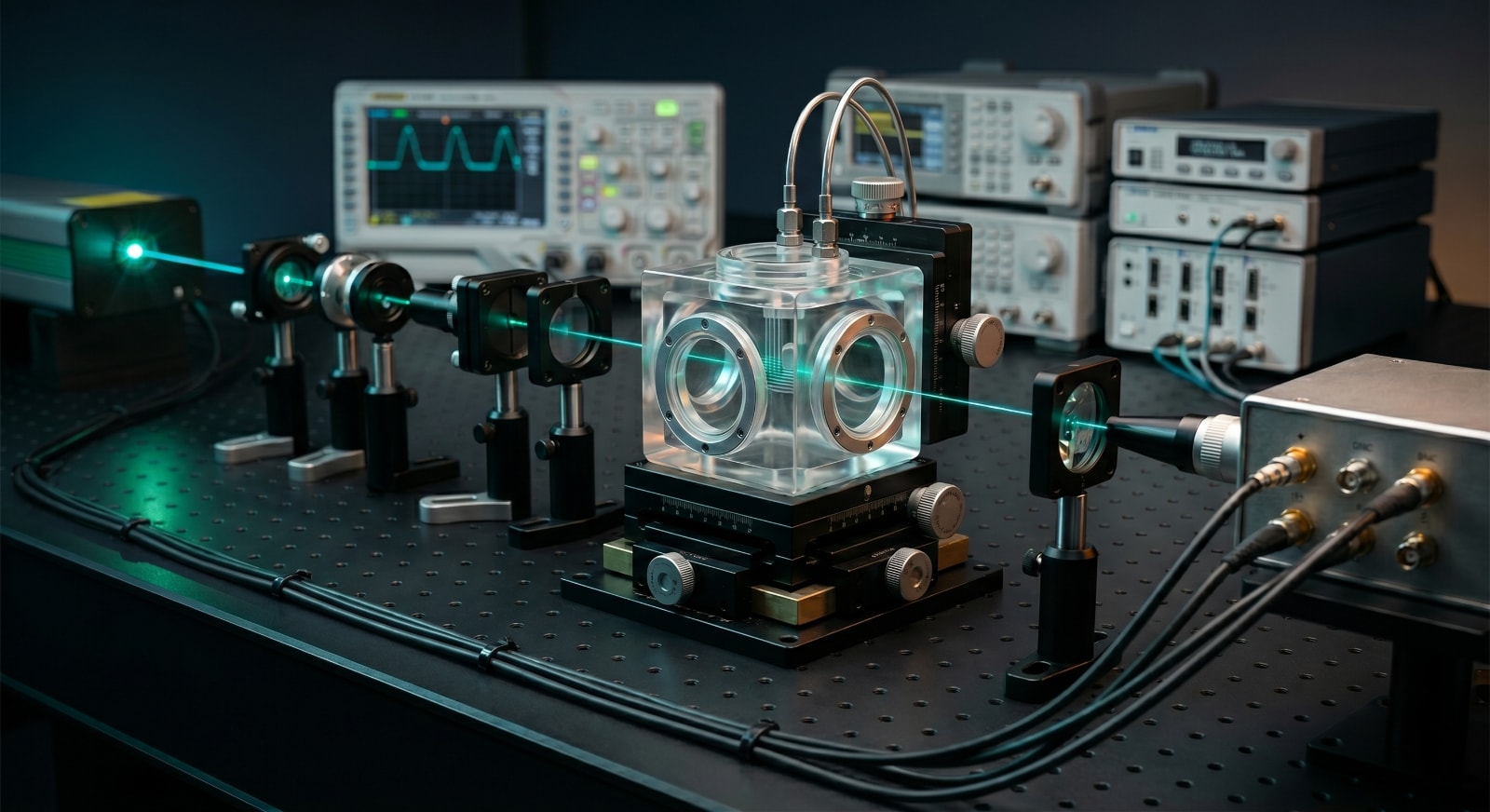
We build hardware and protocols to test whether coherent driving, sharper measurement, and energy-accounted feedback open distinct regimes of measurement and control. We publish the prediction before the data, define win conditions up front, and track the energy bill.

We're not here to win arguments. We're here to make effects replicate.

We score results with two practical gauges:

  • Measurement scaling: how do apparent discreteness or uncertainty change as measurement bandwidth and precision increase?
  • Steering per joule: how much reliable control does a strategy achieve for the energy it spends over a chosen time horizon?

Together they act as design gauges: one tells us what measurement regime a bench is operating in, and the other tells us whether that regime actually buys better steering than strong baselines under declared constraints.

We run prediction-first campaigns with hard controls, full energy accounting, and stop rules — so claims can actually fail.


The bet we are testing

Change the measurement-and-control regime and the system's measured behavior should change in predictable ways — even when the underlying physics is unchanged.

We are testing three linked, measurable claims:

  • Programmable coherence: structured driving produces a reproducible regime shift that cannot be explained by heating alone.
  • Bandwidth-dependent discreteness: increasing bandwidth changes apparent discreteness or uncertainty in a declared scaling pattern or band structure.
  • Control has a cost: under full energy accounting, some strategies deliver more reliable steering per joule than others.

The deeper later-phase claim: If these operational claims hold across well-controlled benches, they justify testing whether current physical laws — including constants like ℏ, c, and G — are stable effective regimes in a larger rule-space rather than fixed axioms. That remains speculative until the early validation phases succeed.


What CCT gives you, even before deeper claims

CCT is designed to pay off early as an engineering and diagnostic lens. The first dividends are new measurement protocols, control strategies, and cross-domain benchmarks — well before any claim about "new laws."

Those gauges are practical tools for replication and transfer. One helps diagnose coherent regimes as you change bandwidth and precision. The other reports control per joule under a full energy ledger.

Even if you're skeptical of the bigger picture, these tools are useful now.


Three documents — and why you need each

Document What it answers Why you need it
Philosophical Essay If reality is continuous, why does it look discrete? What does "observer-stable law" even mean? Skip this and you'll misread CCT as digital physics or simulation theory. This is the guardrail.
Preprint What are the claims in operational terms — and what would falsify them? Skip this and you won't know what counts as failure. Definitions, Baby Theorems, phase-gated validation, early calibration data.
Main Prospectus What are we building first, and how will we know it worked? Skip this and you won't know the bench hierarchy or decision gates. Year-1 validation path, collaboration needs, and what counts as an engineering win.

What is happening now

  • Defined hardware campaigns: a purpose-built measurement-mode bench, a controller-selection bench under matched resources, and coherent-vs-thermal control benchmarks, all with declared controls and baselines.
  • Evidence so far: simulation and cross-domain calibration to de-risk regimes and estimators, plus toy-model theorem results inside explicit model classes to constrain what the metrics can mean.
  • Constraint-complete validation: we treat real actuator limits (delay/low-pass) and regime drift/noise as part of the claim, and we only count control/estimation stacks that survive finite-shot noise and holdout conditions.
  • Current focus: calibration and replication across materials, coherence, and measurement scaling.

Simulation reduces risk, but bench replication is where the rubber meets the road. For the bench map and decision gates, see the Main Prospectus.


Where this matters first

The first target is not "everything." It is a small set of domains where measurement limits, coherence, and control cost visibly matter.

  • AI: Devices that settle into answers instead of calculating step by step. The question is whether some architectures buy more useful steering per joule than others.
  • Biology: Tissues control growth and repair through electrical signals. The question is how controllable these systems are under bandwidth and energy constraints.
  • Space: Field-based positioning instead of onboard fuel. The question is whether coherence-driven control scales beyond sensing into useful propulsion-relevant architectures.

AI and biology serve as calibration and partner domains rather than full in-house verticals. Near-term in-house work stays concentrated on the measurement and control benches above. Space is the longer-horizon in-house application focus if the earlier hardware program earns it.


What we publish

We will publish:

  • measurement-scaling results (including uncertainty and estimator details)
  • steering-per-joule results with baselines and a full energy ledger
  • preregistrations, protocols, and replication outcomes (including negatives)
  • analysis tools and benchmark workflows needed to evaluate those claims

Bold ideas deserve ruthless testing. Our methods, analysis tools, and results are public; implementation specifics that function as build recipes are shared selectively through collaborations and partner builds.


Reference


About CCT Labs

CCT Labs is an independent research-and-engineering lab at the intersection of physics, information theory, and philosophy.

What you can measure changes what you can call real.

Physics usually asks: what are the laws? We ask a simpler question: what stays the same when you change how you measure it?

We call this program the Continuum Computation Thesis (CCT): the idea that reality may be one continuous process, and that many of the "steps" we see (particles, clicks, pixels) may come from how we measure, not from nature being built out of little chunks.

Think of it like music. The sound wave is smooth and continuous. But when you record it digitally, the recording software chops it into samples. The "steps" aren't in the music — they're in the recording equipment. Better equipment, smoother sound.

CCT asks: what if the same is true for physics? What if "quantum jumps" and "particle counts" tell us as much about our instruments as they do about the world?


What we're building

CCT Labs is a research lab that builds equipment and runs experiments to test this idea. We don't just argue about physics — we make predictions, build things, and see if they work.

Our two main questions:

  1. Does sharpening the measurement smooth out the "steps"?
    If discreteness is an artifact of limited instruments, then better instruments should reveal smoother behavior.

  2. How much control do you get for the energy you spend?
    Every system has a "steering cost." We measure it and compare across platforms.

We publish our predictions before we collect data, define what counts as success or failure up front, and track every joule of energy we use. If we're wrong, we'll know.

Real systems are messy: controllers have delay, devices drift, and measurements are noisy. So we only count results that still work when you test them on conditions you didn't tune on.


Why this matters

If CCT is right, the same principles should apply across very different systems:

  • AI: Instead of step-by-step calculation, devices that "settle into" answers — like water finding its level. We measure how efficiently this works.
  • Biology: Living tissues use electrical signals to control growth and healing. We measure how "steerable" these systems are.
  • Space: If field-based control scales, you might not need as much onboard fuel. The infrastructure does the pushing.

AI and biology are early test domains, mostly through partner work rather than areas where we plan to build everything ourselves. Our near-term in-house effort stays concentrated on the measurement and control experiments. Space is the long-term goal — but only if the basics work first.


The bet

Here's the core claim, in plain terms:

Change how you measure and control a system, and what the system "looks like" should change in predictable ways — even if the underlying physics hasn't changed.

We're testing three things:

  1. Coherent control works: If you drive a system with precisely timed signals (not just heat), you should see a shift in its behavior that heat alone can't explain.
  2. Better measurement = smoother behavior: As instruments get sharper, the "graininess" of observations should decrease in a predictable way.
  3. Control has a price tag: Some strategies give you more reliable steering per unit of energy. We can measure this.

The deeper claim: If all of this holds, it opens the door to asking whether the "constants" of physics (like the speed of light or Planck's constant) are truly fixed — or whether they're just very stable habits that reality has settled into. That is the bold part. The experiments come first.


What you get even if the big story is wrong

Even if CCT's broader claims don't pan out, the tools we're building are useful:

  • Better ways to measure coherence in physical systems
  • A common way to measure control per unit of energy that works across labs and domains
  • Protocols that can be replicated — including the failures

These are practical engineering tools, not just philosophy.


What is happening now

  • One experiment tests the measurement story: can changing the way we read the signal change how discrete the same underlying system appears?
  • One experiment tests the control story: can a CCT-guided controller beat standard design choices under matched resource limits?
  • One benchmark tests structured control versus brute-force heating: can structure beat heating on energy efficiency?

Simulation helps us choose promising regimes, but hardware is where the real decision gets made.


Where to go next

If you want... Read this
The full picture in plain language Plain-English Guide (10 min)
The philosophy behind CCT Philosophical Essay
The technical claims and how we test them Scientific Preprint
What we're building and when Main Prospectus
Common objections, answered FAQs for Skeptics

About CCT Labs

CCT Labs is an independent research lab at the intersection of physics, information, and engineering.

We believe bold ideas deserve ruthless testing. Our methods, analysis tools, and results are public; build recipes and partner-specific implementations are shared selectively. Skepticism is welcome.

Ready to start? Read the Plain-English Guide.